




High-volume hiring is a fundamentally different operating model. When you're filling 100+ roles per quarter, every manual step becomes a bottleneck and every inefficiency multiplies across dozens or hundreds of requisitions simultaneously.
A recruiter can manually screen 50 applications per day, which works fine when you have one opening. When you have 20 openings, that same recruiter faces 1,000 applications. They can't screen them all. Qualified candidates get lost. Quality suffers. Candidates wait weeks for responses, damaging your employer brand in competitive talent markets.
Modern high-volume hiring requires rethinking the entire process. This guide covers how TA teams in 2026 hire at scale without burning out recruiters or sacrificing the candidate experience that attracts top talent.
What is high-volume hiring?
High-volume hiring typically means filling 100+ positions per month or hiring repeatedly for the same role. This is common in retail, hospitality, healthcare, logistics, business process outsourcing (BPO), contact centers, and fast-growing tech companies.
What distinguishes high-volume hiring is that the operating model is fundamentally different from standard recruiting. In standard hiring, you have a few open roles, invest significant time in screening and interviews, and make selective hires. In high-volume hiring, you have dozens or hundreds of open positions, screen thousands of applicants weekly, and make rapid hiring decisions prioritizing speed and quality simultaneously.
The metrics are different, too. Standard recruiting tracks time-to-hire measured in weeks. High-volume hiring measures it in days. Standard recruiting evaluates candidate experience by surveying offers accepted. High-volume hiring judges it by response time to applications (candidates expect replies within 24 hours). Standard recruiting uses one recruiting coordinator. High-volume hiring requires automated systems.
The biggest challenges of high-volume hiring
The screening bottleneck. When you have thousands of applications per role per week, manual screening becomes impossible. Even with a dedicated screening team, you can't review every application carefully. Qualified candidates fall through the cracks because you ran out of time before finding them.
Scheduling complexity at scale. Coordinating 100+ interviews per week across multiple hiring managers, interviewers, and candidate time zones becomes a logistics nightmare. Manual scheduling takes hours daily and still results in errors, double-bookings, and candidates waiting days for interview confirmations.
Candidates experience degradation. In high-volume hiring, candidates often wait days for interview confirmations, receive impersonal rejection emails weeks after applying, or experience ghosting when communication breaks down. This damages your employer brand in competitive markets where candidates have choices.
Quality-of-hire pressure. The speed demands of high-volume hiring can push TA teams to prioritize speed over quality. You might hire someone less qualified because they're available now rather than waiting for a stronger candidate. When multiplied across 100 hires, this quality gap compounds.
Recruitment fraud at scale. High-volume hiring attracts fraudulent applicants because sheer volume creates detection gaps. Fake resumes, synthetic identities, and stolen credentials get mixed into thousands of legitimate applications. With limited time per application, fraudsters succeed because thorough manual verification isn't feasible. Bad hires from fraudulent waste onboarding resources create security risks and damage team dynamics.
Reporting and visibility complexity. With dozens of open requisitions at different hiring stages, conversion rates, and bottlenecks, traditional monthly reporting is too slow. You need real-time visibility into pipeline health across all open reqs to identify and fix bottlenecks before they create hiring delays.
High-volume hiring strategies that actually scale
1. Automate application screening with AI
The #1 bottleneck in high-volume hiring is application screening. With thousands of applications per role, manual review is impossible. Qualified candidates drown in the volume.
AI-powered application screening evaluates every applicant against consistent criteria, no matter how many applications arrive. The AI ranks candidates by fit, surfaces the top 10-20 for recruiter review, and automatically progresses candidates who pass initial screening to interview scheduling.
The impact is dramatic. Instead of recruiters screening 50 applications per day and stopping when time runs out, the AI screens all 1,000 applications that week. No candidate is missed due to volume. Quality assessment is consistent because the same criteria apply to every candidate.
At scale, this is the difference between hiring 80% of your target and hiring 100%. The qualified candidates that would normally get lost in volume now advance to interviews.
2. Build always-on sourcing pipelines
In standard recruiting, sourcing starts when a req opens. In high-volume hiring, you can't afford to start sourcing for 20 new roles simultaneously. You'll never fill them in time.
The solution is continuous sourcing pipelines where AI sourcing agents proactively identify candidates for high-volume roles weeks before they're formally open. You build talent pools for "retail associate," "customer service representative," "nurse," or whatever your high-volume roles are, and keep sourcing continuously.
When a requisition opens, you already have 100+ qualified candidates in the pipeline. Interviews start immediately. Time-to-fill drops from 45 days to 15 days because sourcing happened before the req opened.
Talent rediscovery is crucial at high volume. Past applicants who were rejected in previous hires may be perfect for new openings. AI rediscovery automatically matches past candidates to new roles, immediately adding them back to consideration without manual searches.
3. Standardize and templatize everything
At high volume, consistency is what makes the process manageable. If every job description, every screening criterion, and every interview is different, you're rebuilding the process for each role.
Standardization means: consistent job description templates for each role family, standardized screening criteria that apply across all roles of that type, standardized interview scorecards so every interviewer evaluates candidates on the same dimensions, and templated offer letters and rejection communications.
Once you have a "customer service representative" template, opening 20 customer service roles uses that same template with minor customization. Screening criteria apply consistently across all 20 roles. Interviews use the same structure and scoring.
Standardization reduces both the work required and the variation in outcome. Quality becomes predictable because the same standards apply everywhere.
4. Implement self-scheduling at scale
Manual interview scheduling breaks at 50+ interviews per week. Coordinating availability across candidates, multiple interviewers, hiring managers, and meeting rooms becomes a full-time job.
Self-scheduling lets candidates choose from available interview slots directly. The system shows open times in the recruiting calendar, candidates select what works for them, and confirmations are sent automatically. No recruiter coordination required.
This solves two problems simultaneously: recruiters reclaim hours daily (no more back-and-forth emails about scheduling), and candidates get faster confirmations (interview confirmed within minutes of selection rather than after the recruiter coordinates).
At scale, self-scheduling is table stakes. The efficiency difference between manual and self-serve scheduling is often 20+ hours per week for a team hiring 100+ people monthly.
5. Use multi-channel automated outreach
Single-channel outreach (email only) limits response rates. At high volume, you need candidates to respond quickly, and some respond better to different channels.
Multi-channel outreach sends personalized sequences across email, LinkedIn InMail, SMS, and WhatsApp. A candidate who doesn't respond to email might respond to LinkedIn or SMS. Automated sequences follow up appropriately without requiring manual recruiter intervention.
At scale, multi-channel outreach improves response rates from ~15% (email only) to 30-40% (multi-channel). With hundreds of outreach messages weekly, that percentage difference multiplies into dozens of additional qualified candidates engaged.
The automation is crucial. You can't have a recruiter manually reaching out to every candidate on multiple channels. Automation lets you achieve multi-channel coverage at scale.
6. Prioritize candidate experience as a competitive advantage
In high-volume markets like retail and hospitality, candidate experience IS your employer brand. You're hiring hundreds of people. Those candidates talk to friends, post on social media, and influence your reputation.
Candidates expect fast responses. Apply at 9 am, get a response by 5 pm the same day. Candidates expect clarity. Know exactly what the interview process entails and how long each stage takes. Candidates expect respect. Receive polite rejection emails, not ghosting or days of silence.
At scale, this seems impossible. How can you respond to every application the same day when you get 500 applications? The answer is automation. Automated confirmation emails are sent for every application within minutes. Templated rejection emails are sent within 24 hours of a decision. Scheduled status updates keep candidates informed throughout the process.
Candidate experience automation is respectful and professional. It shows candidates they matter, even in a high-volume process.
7. Segment roles by hiring complexity
Not all high-volume roles are the same. A retail associate has different hiring requirements than a skilled trades position. A seasonal role has different timelines than a permanent role.
Segmenting roles by complexity lets you optimize each hiring process separately. Entry-level roles might use simple screening + group interviews + immediate hire decisions. Skilled roles might use technical assessments + multiple rounds + reference checks. Seasonal roles might use rapid hiring + lower bar + shorter time-to-start.
One-size-fits-all processes create friction. Applying skilled hiring processes to entry-level roles slows everything down. Applying entry-level processes to skilled roles compromises quality. Segmentation ensures each role type uses the process designed for it.
This also helps with volume planning. If you know entry-level hiring has a 5-day cycle and skilled hiring has a 15-day cycle, you can stagger sourcing appropriately so requisitions fill on schedule.
8. Consolidate your tech stack
At high volume, fragmented tools (separate ATS + sourcing tool + scheduling tool + CRM + analytics) create data gaps, manual data transfers between systems, and recruiter friction from context switching.
When sourcing happens in one system, screening in another, and offer management in a third, the candidate context is lost at each handoff. A recruiter sources a candidate in sourcing software, exports to ATS for screening, and loses track if scheduling is in a separate tool. This friction multiplies across hundreds of requisitions.
Unified platforms reduce handoff friction. Sourced candidates automatically flow into the ATS for screening. Screened candidates flow into scheduling without manual transfers. Candidates flow through offer and onboarding without re-entering data. Each tool has access to the complete candidate history, enabling smarter AI recommendations and eliminating recruiter overhead.
At scale, consolidated platforms often enable 20-30% faster hiring than fragmented stacks because time spent transferring data between systems disappears.
9. Automate fraud detection
High-volume hiring attracts fraudulent applicants precisely because volume creates detection gaps. Fake resumes, synthetic identities, stolen credentials, and deepfake interviews get mixed into thousands of legitimate applications. Manual fraud verification isn't feasible at scale, so fraudsters slip through and create costly bad hires.
Automated fraud detection evaluates every application across multiple fraud signals simultaneously: resume metadata analysis detecting AI-generated content, email and phone validation confirming real contact information, LinkedIn profile consistency with application materials, IP address and device fingerprinting showing whether applicants are real people, employment timeline cross-referencing against public data, and behavioral pattern analysis identifying coordinated fraud attempts.
Gem's AI Fraud Detection Agent evaluates applications with 90%+ accuracy, analyzing billions of data points to identify high-risk candidates before they waste interview time. The system catches 14-28% of applicants as fraudulent on remote technical roles, immediately filtering them from your pipeline.
The business impact is substantial. A single fraudulent hire costs $17,000+ in direct onboarding costs plus productivity losses from training someone who can't perform. Multiply that by 100+ hires annually in high-volume recruiting, and fraud represents a massive hidden cost that automated detection prevents.
At scale, fraud detection isn't optional. The volume of applications makes manual verification impossible. Automated detection protects your hiring pipeline, your team from bad hires, and your security from fraudulent employees accessing systems under false identities.
10. Track metrics in real time, not retrospectively
At high volume, monthly reporting is too slow. By the time you identify a bottleneck in last month's data, you're already behind on this month's hiring.
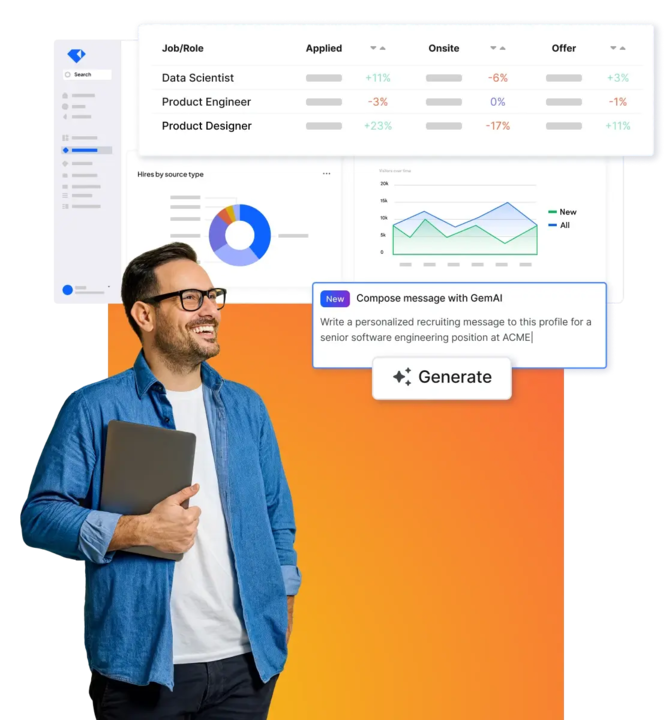
Real-time dashboards continuously show pipeline health: how many candidates are in each stage for each role, where they're getting stuck, which sources produce the best candidates, conversion rates from application to offer, and time-to-fill for each role.
With real-time visibility, you can identify bottlenecks and fix them immediately. If applications are screening but not advancing, you can investigate and adjust. If a source produces low-quality candidates, you can reallocate sourcing effort. If time-to-fill is falling behind, you can increase sourcing to avoid missing targets.
The difference between monthly and real-time reporting at scale is often 10-20 days in time-to-fill. Early detection of problems means earlier intervention.
High-volume hiring and AI: What's changed
Before AI, high-volume hiring required proportionally more recruiters. If one recruiter can manage 20 hiring requisitions, 100 requisitions require 5 recruiters. The math was linear: more volume meant more headcount.
AI fundamentally breaks that math. AI agents handle sourcing (identifying candidates without manual search), fraud detection (flagging suspicious applications automatically), screening (evaluating applications at speed), and initial engagement (personalized outreach at scale). Recruiters focus on interviews, closing candidates, and managing relationships with hiring managers.
A team of 3-4 people using AI sourcing, screening, and engagement can manage 100+ requisitions simultaneously. What previously required 5 full-time recruiters can now be handled by AI, augmenting the work of 3 people.
Instead of spending 80% of time on sourcing and screening, they spend 80% on relationship building, interview evaluation, and closing - the work that actually determines hiring quality.
For organizations hiring at high volume, this shift is transformative. You can dramatically expand hiring capacity without proportionally increasing recruiting headcount. You can also improve quality because recruiters have more time for the human evaluation that AI can't provide.
High-volume hiring in 2026 looks fundamentally different from 2010. Automation, AI agents, and better tools enable hiring hundreds of people each month while maintaining quality and candidate experience.
Gem's all-in-one recruiting platform is purpose-built for high-volume hiring, combining AI sourcing, automated screening, self-scheduling, multi-channel engagement, and real-time analytics in one system, so your team can manage hundreds of requisitions simultaneously without the tool fragmentation that slows traditional stacks.
FAQ
What is high-volume hiring?
High-volume hiring typically refers to organizations filling 100+ positions per month or hiring repeatedly for the same role type. It's common in retail, hospitality, healthcare, logistics, customer service centers, and fast-growing companies.
What distinguishes high-volume hiring from standard recruiting isn't just the quantity but the operating model. In high-volume hiring, you have dozens or hundreds of open positions simultaneously, receive thousands of applications weekly, make hiring decisions rapidly, and prioritize filling roles quickly while maintaining acceptable quality.
The metrics are different, too. Standard recruiting measures success by quality of hire and time-to-hire in weeks. High-volume hiring measures success by cost per hire, quality per hire, and time-to-fill in days, while scaling to 100+ concurrent requisitions.
What industries use high-volume hiring?
High-volume hiring is essential in industries with high turnover, rapid growth, or both.
Retail and quick-service restaurants hire hundreds of seasonal and permanent staff, with constant turnover requiring ongoing hiring to maintain staffing levels.
Hospitality and travel (hotels, airlines, attractions) experience seasonal peaks that require rapid hiring of frontline staff.
Healthcare (hospitals, clinics, nursing homes) face nursing shortages and continuous staffing needs across multiple clinical and non-clinical roles.
Logistics and warehousing (Amazon, FedEx, UPS) hire massive numbers of warehouse workers seasonally and year-round.
Contact centers and BPOs (customer service, tech support) hire hundreds of agents continuously due to growth and turnover.
Tech companies during growth phases need to hire engineering, sales, and support teams rapidly as they expand.
Staffing and recruiting firms themselves need high-volume hiring processes to manage their own employees and contractors.
Any organization experiencing rapid growth or managing businesses with high turnover encounters high-volume hiring challenges and needs specialized processes and tools to manage effectively.
How do you maintain quality in high-volume hiring?
Quality in high-volume hiring requires deliberate process design rather than hoping for the best. Several strategies help maintain quality while scaling:
Standardize screening criteria so every applicant is evaluated against consistent standards, eliminating subjective variations that creep in when manual screening is rushed.
Use skills assessments and work samples that objectively evaluate capability, preventing overreliance on resume and interview impressions that may not predict job success.
Implement structured interviews with the same questions asked in the same order for all candidates of the same role type, reducing interviewer subjectivity and improving consistency.
Use reference checks selectively for key roles or candidates who will manage others, ensuring you verify crucial claims before hiring.
Monitor quality metrics like retention rates, performance ratings, and error rates by hiring cohort so you can adjust your process if quality slips.
Segment by role complexity so you're not applying one-size-fits-all processes to roles with very different requirements.
Quality at high volume is achievable. It requires matching hiring rigor to role requirements and automating the repetitive work so recruitment teams have time for the human evaluation that maintains quality.
What is a good time-to-fill for high-volume roles?
Time-to-fill varies dramatically based on role type and labor market tightness, but reasonable targets for high-volume hiring roles are:
Entry-level/unskilled roles (retail associate, fast food worker, warehouse associate): 10-15 days from requisition to hire. These roles are high-volume precisely because turnover is high and the barrier to entry is low. Faster is better, but less critical because you hire continuously.
Semi-skilled roles (customer service, administrative): 15-25 days. Some screening is required to ensure capability, but not extensive.
Skilled roles (nurse, electrician, engineer): 30-60 days. More rigorous screening and verification required to ensure quality.
Seasonal roles: 7-14 days. Rapid hiring is critical before peak season. The quality threshold may be lower because roles are temporary.
The key is consistency. If your target is 15 days for entry-level roles, you should hit that consistently. Miss those targets and either reduce quality or increase staffing.
Time-to-fill in high-volume hiring is about predictability. Organizations win by consistently hitting targets, not by occasionally hiring at breakneck speed. A reliable 15-day cycle is better than inconsistent cycles ranging from 10 to 30 days.
Use real-time dashboards to track time-to-fill by role and identify bottlenecks. If sourcing is the constraint, add more sourcing. If screening is slow, implement AI to speed up evaluation. Target the critical path to improve overall time-to-fill.
Share



Your resource for all-things recruiting
Looking for the latest data, insights, and best practices? Welcome to the Gem blog. We've got you covered.